


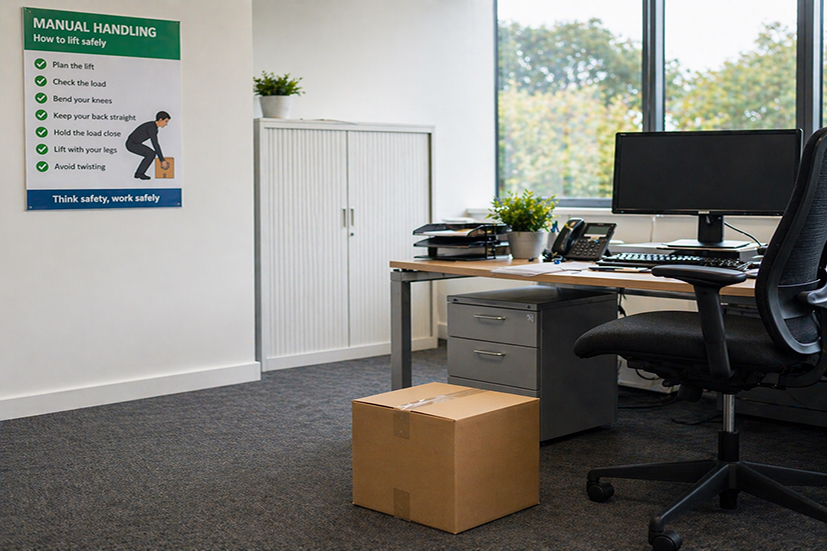
Manual Handling Assessment and Injury Prevention
Manual Handling in Brief
Manual Handling Operations Regulations 1992 ask employers to avoid manual handling where reasonably practicable, assess what cannot be avoided and reduce the risk of injury. HSE has MAC, RAPP and ART tools that help structure the assessment.
Manual Handling at Work
Manual handling covers any activity that involves moving or supporting a load by hand or bodily force. That includes lifting, putting down, pushing, pulling, carrying, and moving. Loads can be anything from a box of paper to a patient in a care setting, or a steel beam on a construction site.
UK musculoskeletal disorder statistics tell a consistent story - manual handling remains one of the biggest sources of injury and time off work. Most of those injuries are preventable with sensible assessment, better working methods, and proper training.
What the Law Requires on Manual Handling
In the UK, the Manual Handling Operations Regulations 1992 (MHOR) set out the key duties. The regulations follow a clear hierarchy:
- Avoid hazardous manual handling operations so far as is reasonably practicable.
- Assess the risk from any manual handling that cannot be avoided.
- Reduce the risk of injury to the lowest level reasonably practicable.
This "avoid, assess, reduce" approach sits alongside broader duties under the Health and Safety at Work etc. Act 1974 and the Management of Health and Safety at Work Regulations 1999. Employers must also provide workers with information on the weight of loads and, where a load has an uneven centre of gravity, the heaviest side.
Assessing Manual Handling Risk - The TILE Approach
The HSE recommends a structured assessment using four factors, easily remembered as TILE:
- Task - what is being done? Frequency, distance, twisting, stooping, reaching, and whether the load is held away from the body.
- Individual - who is doing it? Capability, training, physical build, health conditions, and whether the person is pregnant or has recently returned from injury.
- Load - what is being moved? Weight, size, shape, stability, whether it has handles, and whether it is hot, sharp, or has shifting contents.
- Environment - where is it happening? Floor condition, lighting, temperature, space available, and whether steps or slopes are involved.
A written assessment is not always required - but for any operation with a foreseeable risk of injury, having a recorded assessment makes it far easier to demonstrate compliance and to review the controls over time.
Reducing Manual Handling Risk
Once the assessment identifies risk, the controls follow the usual hierarchy. Eliminate the handling if you can - delivery direct to point of use, vacuum lifters, pallet trucks, hoists, and conveyors all remove the need to carry. Where handling remains, change the task to reduce twisting and carrying distance. Break loads down into smaller units. Improve handholds with crates or straps. Fix the environment - clear the floor, improve lighting, remove trip hazards.
Training is the final layer, not the first. Good technique matters, but it will not compensate for a badly designed task or an overloaded person.
The two questions I always ask when I walk into a workplace are: can this job be done without anyone lifting anything? And if not, what is the lightest version of this job we can design? People jump straight to training because it feels cheap and quick, but training the wrong technique into a badly designed task just delays the injury rather than preventing it.
One area that catches people out is the employee who has been doing the same lifting job for twenty years without issues. Age, health changes, and cumulative wear eventually catch up. Manual handling risk is not static - it needs revisiting when people change, when products change, and when the workplace changes.
And never assume a load is fine because it is under some arbitrary weight limit. The HSE filter figures (25kg for men, 16kg for women when lifted close to the body at waist height) are a starting point for further assessment, not a safe limit.
We found the single biggest improvement on our factory floor was not training, it was buying lift-assists for the three heaviest parts we were moving. Cost paid back in under a year when you factor in the reduction in back strain absence.
The other thing that worked for us was redesigning the drop-off point for raw materials. They used to land on the floor and someone would bend down to lift them onto the workstation. Now the pallet height matches the workstation height. No more bending, no more twisting. Simple, but it took someone actually standing there and watching the job to spot it.
Manual handling is not complicated. Do not lift anything you do not have to, and when you do, keep it close, keep your back straight and do not twist. That is most of it. The paperwork side is proving you thought about the problem - a proper assessment written down, training recorded, and a quick note when something changes.
Practical Compliance Guidance
Section 7 of the IMS1 Manual covers the operational H&S management requirements, including manual handling. It sets out how to structure your assessment process, link it to risk assessment and training, and close the loop with reviews.
The alphaZ documents below cover the policy, assessment, procedural guidance, risk assessment, and training material you need for a compliant manual handling arrangement. A risk assessment sits at the heart of it.
| alphaZ document | How to use it |
|---|---|
| ISO 9001 14001 45001 IMS Toolkit | The full integrated toolkit for ISO 9001, 14001 and 45001. Contains the procedural documents, forms and guidance needed to set up and run a compliant management system including manual handling arrangements. |
| P74 Manual Handling Policy | Sets out your organisation's commitment to managing manual handling risk. Sign, date and issue to workers as part of the wider H&S policy set. |
| PP-7-05 Manual Handling Policy Procedure | The full policy-procedure document covering how manual handling is assessed, controlled and trained. Use as your written procedure for the management system. |
| PP-7-100 Health and Safety Policy Procedure | A single integrated H&S policy-procedure covering manual handling alongside PPE, COSHH, risk assessment and the other core H&S topics. Use as an alternative to separate topic-specific procedures. |
| GG-7-05 Manual Handling Guidance | Plain-English guidance for line managers and workers explaining how to apply the policy on the ground. Issue alongside training. |
| F-HS31 Manual Handling Assessment | The assessment form for individual manual handling tasks. Use for any task where a foreseeable risk of injury exists, and review when tasks, loads, people or the environment change. |
| RA-HS19 Manual Handling Operations Risk Assessment | The general risk assessment covering manual handling operations across the organisation. Tailor to your own activities and review at least annually. |
| TT-7-05 Manual Handling Toolbox Talk | Short briefing material for team meetings. Delivers the key points to workers and provides evidence of awareness training when signed. |
Note - all the above files can be downloaded with an alphaZ subscription.
Frequently Asked Questions
UK Legislation
The following UK legislation is directly relevant to manual handling. Organisations outside the UK should identify the equivalent legislation applicable in their jurisdiction.
- Manual Handling Operations Regulations 1992
- Health and Safety at Work etc. Act 1974
- Management of Health and Safety at Work Regulations 1999
