


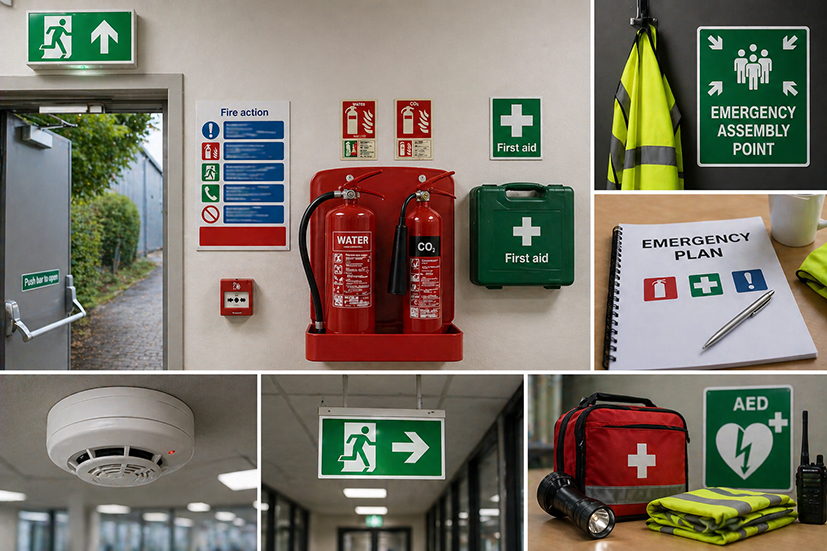
Workplace Emergency Preparedness and Response Planning
Emergency Preparedness in Brief
Foreseeable emergencies need response plans, trained responders and tested procedures. Fire, medical incident, spill, intruder, IT outage and severe weather are typical scenarios for most UK businesses.
Emergency Preparedness
Emergency preparedness is the process of planning for potential emergency situations before they happen, so that if they do occur the response is organised, effective and minimises harm. For organisations pursuing ISO 14001 certification, emergency preparedness and response is a specific requirement under Clause 8.2, which requires the organisation to prepare for potential environmental emergencies and test its response arrangements periodically. ISO 45001 Clause 8.2 has an equivalent requirement covering emergency preparedness for health and safety incidents.
For most organisations the situations that require planning fall into a manageable set: fire and evacuation, environmental spills or releases, medical emergencies, and significant infrastructure failures such as loss of power or flooding. The purpose of planning is not to anticipate every possible scenario but to have clear arrangements for the most likely and significant events, communicated to everyone who might need to act on them.
Fire Safety and Evacuation
Fire is the most universal emergency scenario for any premises. The core requirements are a fire risk assessment, a clearly communicated evacuation procedure, designated fire marshals who know their role, an identified assembly point, and regular fire drills. The Regulatory Reform (Fire Safety) Order 2005 requires all of this for any workplace.
The evacuation procedure should be simple enough that everyone can remember it: on hearing the alarm, leave the building by the nearest safe exit, do not use lifts, go to the assembly point, do not re-enter until told it is safe. Fire action notices posted at exit points and call points are the standard way to communicate this.
Fire drills should be carried out at least annually and the outcome recorded - time taken to evacuate, any issues found, actions taken. Drills that identify problems are doing their job.
Environmental Emergencies
ISO 14001 Clause 8.2 specifically requires the identification of potential environmental emergency situations - such as chemical spills, oil leaks, fuel releases or uncontrolled discharges to drains or watercourses - and documented procedures for how these would be managed. The procedure should cover who is responsible, what containment materials are available and where, who to notify in the event of a significant release, and how to record and review the incident afterwards.
For organisations with limited environmental risk, a brief documented review of potential scenarios and the controls in place is sufficient. The key is that the organisation has thought about it before an incident occurs, not during one.
Medical Emergencies
Having a clear process for responding to a medical emergency is part of any first aid arrangement. This includes knowing where the first aid kit is, who the first aider or appointed person is, and having emergency contact details - including the site address - readily available for anyone needing to call the emergency services. Displaying these details prominently in the workplace is a simple and effective measure.
Reviewing and Testing Emergency Arrangements
Both ISO 14001 and ISO 45001 require that emergency preparedness arrangements are tested periodically. A fire drill tests the evacuation procedure. A tabletop exercise - talking through how the team would respond to a hypothetical spill or incident - tests environmental and other emergency procedures without the disruption of a live exercise. After any actual incident or drill, the arrangements should be reviewed and updated where gaps are identified.
The two things that most often go wrong in real emergencies are: people do not know what to do because the procedure was never communicated clearly, and the emergency contact details are not available at the point they are needed. Both are avoidable. Posting the evacuation procedure and emergency contacts at visible locations around the premises costs nothing and removes both problems. A fire drill once a year and a review of emergency arrangements after any incident is all most organisations need to have this genuinely under control.
For ISO 14001 Clause 8.2, auditors want evidence that the organisation has identified its potential environmental emergency scenarios and documented how it would respond. For most small organisations this does not need to be an elaborate document - a clear procedure covering the most likely scenarios, evidence it has been communicated to relevant staff, and a record of any drills or reviews. If you have had an actual environmental incident, the review of that incident and the actions taken from it is itself good evidence of an effective emergency response process.
Practical Compliance Guidance
Emergency preparedness arrangements should be documented and communicated, with records kept of drills, incidents and reviews. Section 6.3 of IMS1 covers environmental incident prevention and management, and the health and safety emergency arrangements sit within Section 7. The documents below support a compliant approach to ISO 14001 Clause 8.2 and ISO 45001 Clause 8.2.
The alphaZ document suite includes specific forms for fire safety, spill recording, emergency contact details and business continuity alongside the broader inspection and assessment forms.
| alphaZ document | How to use it |
|---|---|
| ISO 9001/14001/45001 Management System Toolkit | The complete toolkit for implementing an ISO-compliant integrated management system. Includes the IMS1 manual, procedures and registers covering emergency preparedness requirements for ISO 14001 and ISO 45001. |
| F-HS28 Fire Safety Risk Assessment | Use to document the fire risk assessment for your premises - identifying ignition sources, people at risk and the fire safety measures in place. |
| F-ENV5 Fire Safety Inspection | Use to record periodic fire safety checks - extinguishers, exits, fire action notices and alarm testing. |
| F-HS11 Site Safety Emergency Details | Use to record and display emergency contact details for the site - emergency services, first aiders, site address and assembly point. Post in a visible location. |
| F-ENV7 Spill Record Form | Use to record environmental spill or release incidents - what happened, how it was contained and what actions were taken. |
| F-IMS21 Business Continuity Register | Use to document business continuity arrangements - covering how critical operations would be maintained following a significant incident. |
Note - all the above files can be downloaded with an alphaZ subscription.
Frequently Asked Questions
UK Legislation
The following UK legislation is directly relevant to emergency preparedness. Organisations outside the UK should identify the equivalent legislation applicable in their jurisdiction.
- Regulatory Reform (Fire Safety) Order 2005
- Management of Health and Safety at Work Regulations 1999
- Health and Safety at Work Act 1974
- Environment Act 1995
