


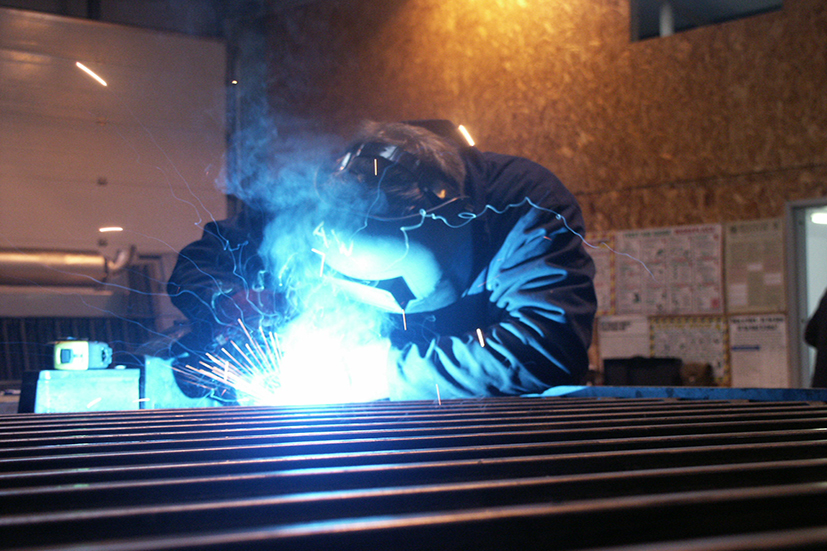
Welding Fume Control and Welder Safety Management
Welding Fume in Brief
- All welding fume now classified as a carcinogen by HSE since 2019
- LEV on the source plus respiratory protection where LEV cannot capture it
- Health surveillance for regular welders
Welding Fume and Welding Safety
Welding is a skilled, everyday process in manufacturing, construction and engineering - but the fume it produces is hazardous to health in ways that have only been fully recognised in recent years. In 2019 the UK's Health and Safety Executive (HSE) updated its position based on evidence from the International Agency for Research on Cancer, and now treats all welding fume, including mild steel fume, as capable of causing cancer. There is strong evidence linking welding fume to lung cancer and some evidence for kidney cancer.
The practical effect of that change is that employers can no longer rely on general ventilation and a welding mask as a sufficient control. Local exhaust ventilation (LEV) and respiratory protective equipment (RPE) are now the baseline expectation wherever welding is carried out indoors or in any enclosed or semi-enclosed space.
The Health Risks of Welding Fume
Welding fume is a mixture of very fine particles and gases produced when metal is heated to its melting point. The composition varies with the base metal, any coatings, the consumable used, and the welding process - but all of it is hazardous. Short-term exposure can cause metal fume fever, irritation of the eyes, nose and throat, and acute respiratory symptoms. Long-term exposure is associated with lung cancer, kidney cancer, chronic obstructive pulmonary disease, and other occupational respiratory conditions.
Stainless steel welding produces hexavalent chromium, which is separately classified as a carcinogen. Galvanised steel releases zinc oxide, a known cause of metal fume fever. Aluminium and its alloys can produce ozone. Welding on painted, oiled or contaminated surfaces adds further hazards on top of the base-metal fume. Every welding process has its own COSHH profile and should be assessed on its own terms.
Controlling Welding Fume at Source
The hierarchy of control applies to welding fume as it does to any other airborne hazard. In order of preference:
- Elimination - design out the welding operation where practicable, for example by redesigning a component to be bolted rather than welded
- Substitution - use a lower-fume process where one exists for the job, or switch to consumables that produce less hazardous fume
- Engineering controls - local exhaust ventilation (LEV) capturing the fume at source, on-torch extraction where possible, fixed LEV hoods for bench work, or mobile extraction for site work
- Administrative controls - sectioning off welding areas from other workers, scheduling welding to minimise exposure to non-welders, job rotation to reduce individual exposure times
- Respiratory protective equipment (RPE) - powered air-purifying respirators or air-fed welding helmets, matched to the fume hazard and fit-tested to the individual
General ventilation alone is not adequate for welding fume under the current guidance. The HSE expects engineering controls to be in place even for short-duration work, with RPE used in addition - not as the sole control.
COSHH Assessment for Welding
In the UK, welding fume is covered by the Control of Substances Hazardous to Health Regulations 2002 (COSHH). A COSHH assessment is required for each welding process, considering the base material, any surface contamination or coatings, the consumables used, the welding environment and the duration and frequency of the work. The assessment drives the choice of controls and the level of RPE needed.
The COSHH assessment sits alongside a welding risk assessment that covers the other hazards associated with the work - UV radiation from the arc, burns, electric shock, manual handling, fire risk from sparks, and the compressed gases used. Both are needed. The COSHH assessment deals with what workers breathe in; the risk assessment deals with everything else.
Respiratory Protective Equipment for Welding
RPE for welding needs to meet two requirements: adequate protection for the fume present, and compatibility with the welding helmet and visor. The common options are:
- Powered air-purifying respirators (PAPR) integrated with a welding helmet, providing filtered air to the face
- Air-fed welding helmets supplied from a breathing-quality compressed air line
- Half-mask respirators worn under a separate welding helmet (less common, less comfortable, tends to be used for short tasks only)
All tight-fitting RPE - including half-masks and the face-seal variants of some PAPR units - requires face-fit testing to the individual wearer, and a face-fit test must be repeated if the wearer's facial features change significantly (weight change, facial hair, dental work). Loose-fitting RPE (hoods and helmets that do not rely on a face seal) does not require fit testing but does need air-flow checks and regular maintenance.
Records of RPE issue, fit testing, maintenance and user checks should be kept. Most enforcement action in this area is triggered by missing records rather than by missing equipment.
Training and Health Surveillance
Welders need training on the specific hazards of their process, how to use the engineering controls correctly, how to wear and maintain RPE, and what to do if they notice symptoms. Health surveillance is expected where exposure is significant - typically lung function testing and a respiratory health questionnaire, arranged through an occupational health provider. Surveillance is not a control in itself - it is a check that the other controls are working.
The 2019 HSE update on welding fume was a big shift and a lot of smaller engineering firms have not caught up. Welding with a basic flip-up helmet and general ventilation is no longer defensible.
The question I ask when I visit a welding workshop - can you show me the LEV, the RPE records, the COSHH assessment and the health surveillance? If any of those four are missing the organisation has a problem.
And LEV is not fit-and-forget. It needs a thorough examination at least every 14 months under COSHH, and users need to check it before each shift.
We run a small welding bay for repair work. When the HSE guidance changed we upgraded the extraction, got PAPR units for the welders, and built face-fit testing into the induction for anyone who might weld.
The lung function testing threw up one case of reduced capacity - we would not have caught it without surveillance. That worker is fine, we adjusted their role, and the system works.
On a ISO 45001 audit at a site with welding, I look for the COSHH assessment specific to each process, the LEV examination records, evidence of face-fit testing, health surveillance outcomes, and training records. I cross-check these against the incident log to see if anyone has reported symptoms.
A common gap is RPE issue without fit testing. The PAPR hood sits in the cabinet, nobody has been tested to it, and the site is confident it has the RPE sorted. It has not.
Practical Compliance Guidance
Welding management is covered within the hazard identification, COSHH and operational control arrangements in the IMS1 Manual. For organisations that carry out welding regularly, a set of documents specific to the process sits alongside the wider H&S system.
The alphaZ documents below give you a policy-procedure, guidance for workers, risk assessment and COSHH assessment templates, PPE issue forms and a welding record form for documenting the work completed.
| alphaZ document | How to use it |
|---|---|
| ISO 9001, 14001 and 45001 IMS Toolkit | Full integrated management system toolkit containing the welding documents listed below alongside the wider management system templates. |
| PP-7-23 Safe Welding Policy-Procedure | Policy and procedure covering safe welding activities, the controls expected and responsibilities for those involved. |
| GG-7-18 Welding Safety Guidance | Plain-language guidance on welding safety, suitable for issuing to welders and supervisors as reference material. |
| RA-HS06 Welding Risk Assessment | Example risk assessment for welding covering electric shock, radiation, burns, fire risk and manual handling. |
| RA-HS130 Welding - Arc, MIG, TIG Risk Assessment | More detailed risk assessment covering the specific hazards of arc, MIG and TIG welding processes. |
| F-HS5 COSHH Assessment | COSHH assessment template for completing separate assessments for each welding material, consumable and process gas used. |
| COSHH Assessment - Welding Wire | Example completed COSHH assessment for welding wire - useful as a starting point that can be adapted for the specific consumables in use. |
| PP-7-01 Safe Use and Management of PPE Policy-Procedure | Policy and procedure covering PPE including RPE - selection, issue, maintenance, fit testing and user responsibilities. |
| F-Q44 Welding Record | Form for documenting welding work completed, useful for quality records and for traceability where fabrication certification is required. |
| TT-7-18 Welding Safety Toolbox Talk | Short training talk on welding safety covering the main risks and the controls expected. |
Note - all the above files can be downloaded with an alphaZ subscription.
Frequently Asked Questions
UK Legislation
The following UK legislation is directly relevant to welding fume and welding safety. Organisations outside the UK should identify the equivalent legislation applicable in their jurisdiction.
- Control of Substances Hazardous to Health Regulations 2002
- Health and Safety at Work etc. Act 1974
- Management of Health and Safety at Work Regulations 1999
- Provision and Use of Work Equipment Regulations 1998
- Personal Protective Equipment at Work Regulations 1992
